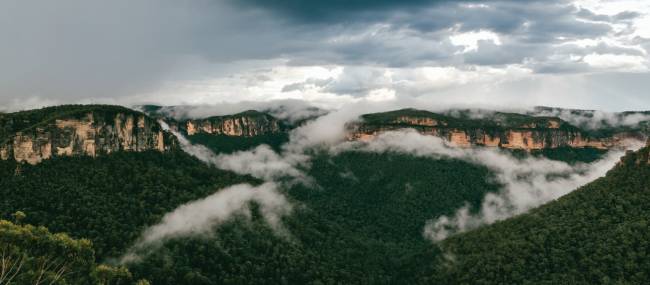
The Grose Valley | Luke Mallinson
Blog home / Canyoning in the Blue Mountains: A brief history
They may be blue, but they are not much more than a thousand metres high and they are not even mountains!
In the language of science, the Blue Mountains are really a dissected uplifted plateau.
It is this incredible dissection of deep valleys and gorges surrounding stubborn peaks that helps make the Blue Mountains the amazing World Heritage-listed place they are. The magic lies not in their heights but in their depths - the amazing places that have been carved into its sandstone soul.
And there is no better way for young people to experience the magic of these depths than to go canyoning.
To venture into the deep, dappled, cold, wet, narrow slot canyons like Serendipity, Whungee Wheengee, Butterbox, Claustral, Empress Falls or Rocky Creek is to not only experience an adrenaline-filled physical challenge full of breath-taking beauty and biodiversity but to travel in a time machine to a hidden and ancient world that helps you fully comprehend why UNESCO deemed this dissected plateau to possess universal values important for all of humanity when it granted it World Heritage status in 2000.
It was only in 1994, for example, that an abseil into a Blue Mountains canyon led to the discovery of the famous Wollemi Pine, a tree from the time of the dinosaurs that was thought to have been extinct for millions of years. This “pinosaur with Jurrasic bark” made headlines around the world.


The ancient canyons have been known to the Aboriginal people of the Blue Mountains for thousands of years, but canyoning can trace its modern beginnings back to the early attempts by white settlers to find a way across the Blue Mountains. It was explorer George Caley who, in 1804, stumbled into what is now Claustral Canyon in the Blue Mountains and named it Dismal Dingle as he became one of the many to be defeated as he sought a way across this dissected labyrinth that compensates for a lack of height with an outrageously rugged landscape.
But it was bushwalking clubs looking for fresh challenges after World War II that really pioneered canyoning as a recreation.
What Caley called “dismal”, modern visitors call enchanting, breathtaking and unforgettable.
World Youth Adventures can assist schools with experiencing the magic of the Blue Mountains' canyon. Talk to our team to learn more.
Adapted from an original blog written by Dan Lewis for the Blue Mountains Adventure Company.